


In short
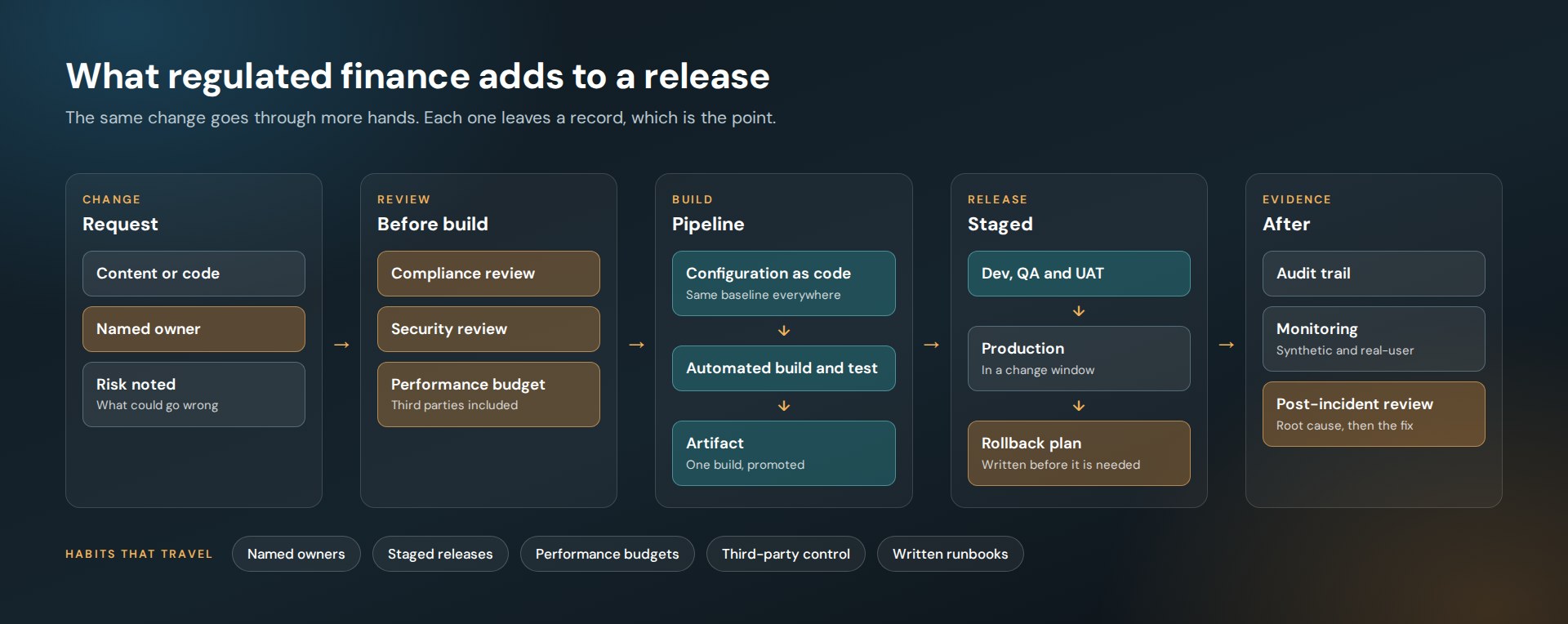
Regulated finance treats a website as a system of record. Every change has an owner, a review, a staged release and a trail. Our background includes sixteen years on platforms run that way, for firms including Allianz Global Investors and PIMCO. Most of those habits cost little and work on any site: name an owner, release in stages, set performance budgets, control third-party scripts, write the rollback plan before the incident and review every outage for its cause.
Why is a finance website different?
An asset manager’s website publishes information that investors rely on and regulators can examine. In the United States that means the SEC and FINRA. In Europe it means GDPR for personal data, along with the rules of each local market.
The consequences shape the engineering. Content needs approval before it is published. Changes need a record. Downtime and wrong numbers are business risks with names attached.
Our experience includes managing global web services for Allianz Global Investors, supporting more than 100 web properties across North America, EMEA and APAC, and leading web services engineering for PIMCO. The habits below come from that work. We use them on every project, including ones with no regulator in sight.
1. Why should every change have a named owner?
Because “the team” cannot answer a question at two in the morning.
On a regulated platform, each change names the person who asked for it and the person who approved it. On a small site the same idea is one line in a ticket. It costs nothing and it ends most arguments about why something changed.
2. Why release in stages?
A staged release moves one build through development, QA, user acceptance and production. The build that was tested is the build that ships.
The enterprise version of this uses CI/CD pipelines and configuration management, so every environment is built the same way. The small-site version is a staging copy and a checklist. Both work for the same reason: problems show up somewhere cheap.
3. What is a performance budget?
A limit you agree on before anyone asks for an exception. Page weight, script count, load time for a template.
Finance platforms run page-speed targets as service levels, with a review before each release. The budget makes the conversation concrete. A new tag is no longer free. It spends something. We explain the metrics in Core Web Vitals on a Large Catalog.
4. Why control third-party scripts?
Every script from another company runs with your page’s permissions. It can slow the page, change it or read what is on it.
In finance, tag governance is a control: an inventory of every tag, an owner for each and a rule about what may load where. Any marketing site benefits from the same inventory. It usually turns up tags nobody remembers adding.
5. How should a site handle privacy signals?
By treating consent as an input to the page, not a banner on top of it.
A multi-region site has to behave differently by region. Tags that need consent wait for it. In California, businesses must honor the Global Privacy Control browser signal as a valid request to opt out of the sale or sharing of personal information, as the California Attorney General explains. Building consent-aware loading into the templates is far easier than retrofitting it.
6. What does a global site teach you about SEO?
That consistency is a technical problem. A firm with sites in many countries and languages needs each page to point at its counterparts, so search engines show the right version to the right reader.
That is what hreflang does, and Google’s rules for localized versions are strict: every version has to list itself and all the others, with full URLs, or the annotations are ignored. We have worked on hreflang governance across more than 30 regional and language variants. At that scale it only works when the template generates the tags from one source.
7. What happens after an incident?
A review. What happened, what the cause was, what changes so it does not happen again.
The useful part is where the review looks. It looks for the cause in the system: the missing check, the unclear runbook, the alert that fired too late. Then it fixes that. Centralized logging, synthetic monitoring and dashboards exist so the next review starts with evidence.
Which of these matter for a smaller business?
All seven scale down. If we had to pick three:
- A staging site and a release checklist
- A tag inventory with an owner per tag
- A written rollback plan for anything that touches checkout or lead forms
None of them needs enterprise tooling. They need someone who has seen what happens without them.
How does this show up in Creartful’s work?
In small ways on every project. Changes to a client’s Shopify theme go to a development theme and are reviewed before publishing, as we describe in AI-Driven Shopify Theme Development. AI output is checked by a person before it ships, which is the same control in a new setting: see AI With a Person at the Wheel. The fuller story is on our About page.
Want enterprise habits without enterprise overhead?
Start a conversationFrequently asked questions
What makes web development for financial services different?
Financial services sites publish information investors rely on and regulators can examine. Content needs approval, changes need a record, and uptime, security and privacy are held to stricter standards than on most marketing sites.
What is tag governance?
Tag governance is the practice of controlling third-party scripts on a site: keeping an inventory of every tag, naming an owner for each, and setting rules for where and when it may load. It protects performance, privacy and security.
What is a performance budget?
A performance budget is an agreed limit for a page or template, such as page weight, number of scripts or load time. New features and tags are checked against the budget before release.
Do small businesses need a release process?
A simple one, yes. A staging copy of the site, a short checklist and a rollback plan catch most problems before customers see them.
